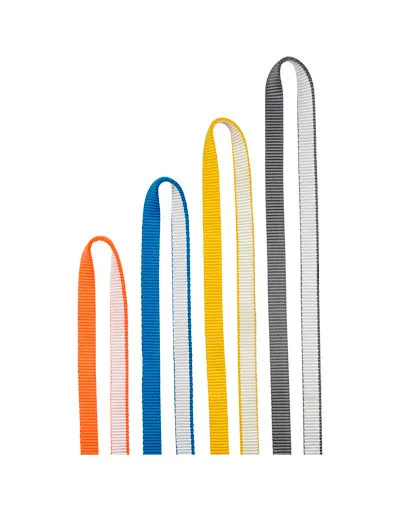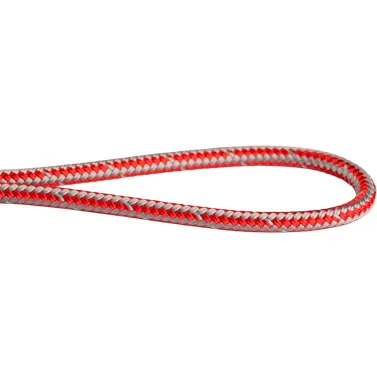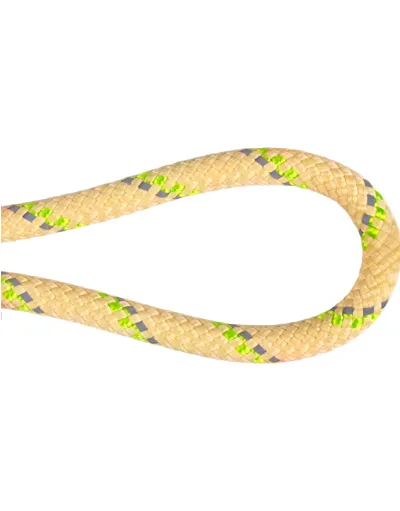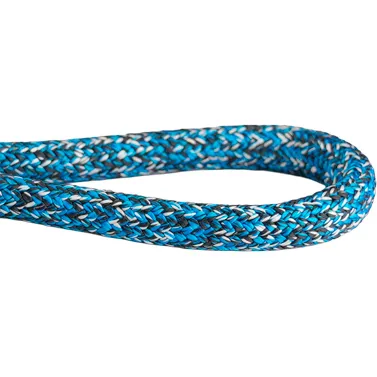
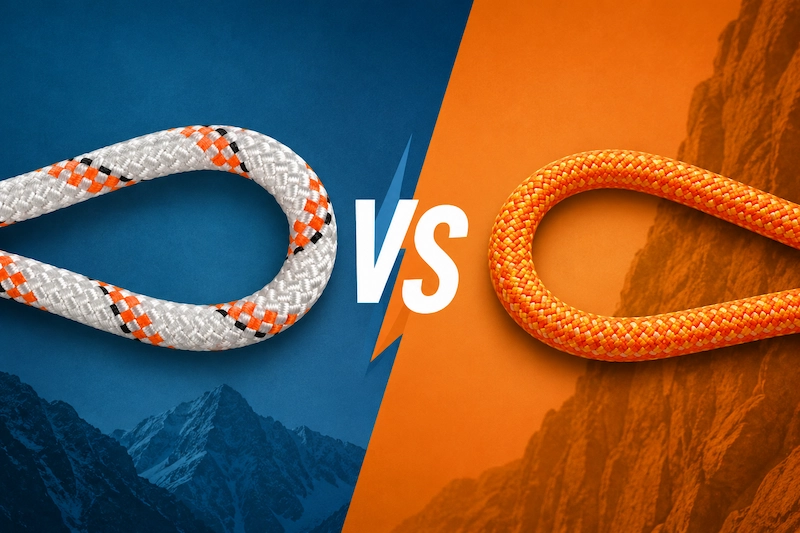
Static rope and dynamic rope serve fundamentally different purposes. Static rope is designed to minimize stretch—typically below 5% elongation under load—making it ideal for applications where the rope must hold position under tension: hauling, lowering, anchoring, and rappelling. Dynamic rope is engineered to stretch significantly—30–40% or more under impact force—to absorb the energy of a falling climber.
Choosing the wrong type is not just a performance issue; it's a safety-critical decision. Using dynamic rope where static rope is required (e.g., rappelling in a rescue operation) can result in uncontrolled descent and positioning errors. Using static rope where dynamic rope is required (e.g., lead climbing fall protection) means the rope cannot absorb impact energy, exposing the user to potentially lethal fall forces.
| Parameter | Static Rope | Dynamic Rope |
|---|---|---|
| Elongation under load | < 5% (typically 1.5–3%) | 30–40% under impact force |
| Primary function | Positioning, hauling, lowering, anchoring | Fall arrest and energy absorption |
| Impact force absorption | Minimal—NOT designed for falls | Designed to absorb fall forces within safe limits |
| Typical construction | Kernmantle (tight core + tight sheath) | Kernmantle (flexible core + sheath) |
| Certification standards | EN 1891 (Type A/B), NFPA 1983 | EN 892 (single, half, twin), UIAA |
| Common diameters | 10–13 mm (rescue), 8–11 mm (industrial) | 8.5–11 mm (single), 7.8–9 mm (half) |
| Weight (approx. per meter, 10.5 mm) | 65–80 g | 60–75 g |
| Typical service life | 5–10 years (inspection-dependent) | 3–5 years (retire after major fall) |
Static rope is the correct choice whenever the rope is used under sustained tension without the need to absorb dynamic falls.
The single largest application for static rope is technical rescue—both professional and volunteer. This includes:
High-angle rescue: Evacuating casualties from cliffs, buildings, towers, and industrial structures
Low-angle rescue: Assisting evacuation on slopes and embankments where the load is partially supported by the ground
Confined space rescue: Lowering and raising personnel and casualties through vertical entries into tanks, silos, tunnels, and shafts
In all rescue scenarios, low elongation is critical. When raising or lowering a casualty, stretch in the system creates several problems: difficulty in precise positioning, unexpected bounce during raising operations, and inaccurate communication between the haul team and the edge tender. A low-stretch rescue rope ensures the load moves predictably.
Industrial rope access technicians (IRATA, SPRAT certified) use static rope as their primary lifeline and working line. The rope supports the technician's weight while they perform inspections, maintenance, and construction at height. Stretch would make work positioning difficult and fatiguing.
Fire departments use static rope for sale for bailout systems, ladder operations, victim removal, and technical rescue. NFPA 1983 classifies rescue rope into Personal Use and General Use categories, both of which are low-elongation.
Controlled descent on a fixed anchor requires static rope. Stretch would cause the user to drop unexpectedly when loading the rope and make descent speed difficult to control.
Any application where rope is used to move loads—hauling gear up a cliff face, tensioning guylines, or setting up anchor systems—benefits from low elongation. The effort you put into hauling translates directly into load movement rather than rope stretch.
Caving and canyoneering involve rappelling and ascending on fixed ropes with no lead climbing. Static or low-stretch rope is standard for these activities.
Dynamic rope is the correct choice whenever there is a risk of a significant fall that the rope must arrest safely.
The defining application for dynamic rope. When a lead climber falls, the rope must stretch to absorb the kinetic energy of the fall, reducing the peak force transmitted to the climber's body, the harness, the belay system, and the protection (anchors, cams, nuts, bolts). Without this energy absorption, even a short fall could generate forces sufficient to cause injury or equipment failure.
Dynamic single rope is tested and rated by the number of standard falls it can hold before retirement (per UIAA and EN 892 standards). Higher fall ratings indicate greater durability and margin.
Even on top rope, where falls are generally short and low-force, dynamic rope is standard because it provides a comfortable catch and protects the anchor system from repeated loading.
Alpine climbing often involves moving together on a rope where the primary purpose is crevasse rescue and short-fall protection. Dynamic rope is required for this application.
This is dangerous. A fall on static rope generates extremely high impact forces because the rope cannot elongate to absorb energy. The peak force is transmitted directly to the climber's body and the protection system. Forces can easily exceed 12 kN (the UIAA maximum for a single rope in a standard fall), potentially causing:
Serious injury or death to the climber
Failure of marginal protection placements
Damage to or failure of the harness, carabiners, or belay device
Static rope must never be used for lead climbing or any application where a dynamic fall is possible.
While not life-threatening in the same way, using dynamic rope for rescue and rigging introduces operational problems:
Unpredictable lowering: The rope stretches under load, causing the load to drop suddenly when first weighted and bounce during lowering
Inaccurate raising: A significant portion of the haul team's effort goes into stretching the rope before the load actually moves
Poor positioning: Rope stretch makes it difficult to hold a casualty or patient at a precise position (e.g., at a window ledge or basket transfer point)
System complexity: Mechanical advantage systems behave unpredictably when the rope stretches under load
Static rope: Typically identified by a marker tape inside the core (visible when you cut the rope) printed with the manufacturer name, standard (EN 1891), rope type (A or B), diameter, and year of manufacture. The sheath is generally smoother and tighter.
Dynamic rope: The core marker tape references EN 892 and UIAA. Dynamic ropes often have a slightly softer, more supple hand feel.
Both types may have identifying information printed on the sheath at intervals. Look for standard references:
EN 1891 = Static / low-stretch kernmantle rope
EN 892 = Dynamic climbing rope
NFPA 1983 = Fire service rescue rope (static)
UIAA mark = Certified for climbing (dynamic)
Static rope feels notably stiffer and holds its shape better when bent. Dynamic rope is more supple and flexible, designed to run easily through carabiners and belay devices with minimal friction.
For fire departments, rescue teams, and industrial access companies sourcing static rope, the following criteria should guide your specification:
| Diameter | Best For | Notes |
|---|---|---|
| 10 mm | Personal rope access, lightweight kits | Lighter but less grip for handling |
| 10.5 mm | Standard rescue, EN 1891 Type A | Most versatile diameter |
| 11 mm | General rescue, fire service, NFPA General Use | Good balance of strength and handling |
| 12 mm | Heavy rescue, training, high-visibility requirements | Easier to grip, especially with gloves |
Nylon core / nylon sheath: Traditional construction with good energy absorption and excellent knot-holding. Slightly higher elongation than polyester-core options.
Polyester core / polyester sheath: Lower elongation, better UV resistance, minimal water absorption. Preferred for many rescue applications where lowest stretch is desired.
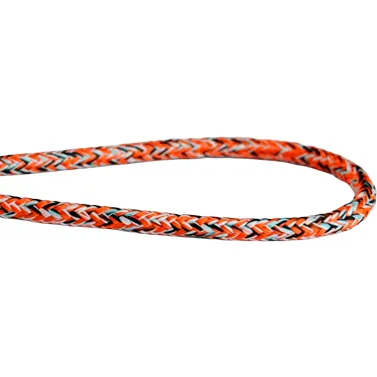
Aramid (Technora®) core: Very high strength, extremely low stretch, excellent heat resistance. Used in specialized rescue and heat-resistant applications. Higher cost and poor flex fatigue.
When procuring rescue rope in volume, specify:
Standard compliance: EN 1891 Type A, NFPA 1983, or both
Diameter and tolerance: e.g., 10.5 mm ± 0.3 mm
Minimum breaking strength: In kN
Elongation at specified load: Typically measured at 50 kg and at 10% of breaking strength
Sheath construction: Material, pick count, color coding
Core marker tape: Required for traceability and standard compliance
Length per spool: Standard spool lengths or custom cut lengths
Certification documentation: Batch test reports and certificates of conformity
A manufacturer that provides all of the above with consistent batch quality is a reliable partner for rescue rope procurement.
Inspect before and after every use for sheath damage, core exposure, soft spots, stiffness, and discoloration
Record usage hours, number of lowers, and any shock-loading events
Wash with clean water after exposure to saltwater, chemicals, or excessive dirt
Store loosely coiled in a cool, dry, dark location—never stored under tension or in direct sunlight
Retirement: After 5 years of regular use, 10 years from manufacture (whichever comes first), or immediately if damaged
Inspect for sheath wear, core shots (visible core through worn sheath), flat spots, and stiffness
Retire after any significant fall (factor > 1) or if UIAA fall rating has been exceeded
Same storage guidelines as static rope
Retirement: After 3–5 years of regular use, 10 years from manufacture, or immediately after a major fall
Technically possible but not recommended. Even on top rope, the climber can take a small fall when loading the rope. Without dynamic elongation, even a short fall generates higher forces than expected. Use dynamic rope for all climbing applications.
Type A ropes have higher minimum breaking strength and lower elongation requirements. They are designed for professional rescue, rope access, and safety applications. Type B ropes have lower requirements and are intended for less demanding applications. For professional rescue rope procurement, always specify Type A.
No, rope color is a manufacturer choice and does not indicate material, strength, or certification. However, many rescue teams use color coding to differentiate rope lengths, diameters, or assigned functions within their kit.
Nylon-based ropes can absorb up to 7–10% of their weight in water, which reduces strength by approximately 10–15% when wet and increases weight. Polyester-based ropes absorb minimal water (less than 1%) and maintain strength when wet. For water rescue and marine operations, polyester-sheath rescue rope is preferred.
They can be, but with caution. For example, a rescue system might use static rope for the main line and dynamic rope for a backup belay. However, the different elongation characteristics mean the two lines will not share load equally. Each line must be independently capable of holding the full load. Consult a qualified rigger or rescue instructor for system design.
| Your Application | Use This Type | Why |
|---|---|---|
| Lead climbing, fall protection | Dynamic (EN 892) | Must absorb fall energy |
| Top-rope climbing | Dynamic (EN 892) | Standard practice, comfortable catch |
| Technical rescue (high/low angle) | Static (EN 1891 Type A) | Precise positioning, predictable lowering |
| Rope access / work at height | Static (EN 1891 Type A) | Stable work positioning |
| Rappelling / abseiling | Static (EN 1891 Type A) | Controlled descent |
| Hauling and rigging | Static | Efficiency, load control |
| Firefighting bailout / rescue | Static (NFPA 1983) | Standard compliance, predictability |
| Caving / canyoneering | Static or low-stretch | Rappel-only applications |
| Mountaineering (glacier travel) | Dynamic | Crevasse fall protection |
For rescue teams and industrial access professionals sourcing static rope, working with a manufacturer that offers certified products across a range of diameters and materials—with full batch traceability and test documentation—ensures both compliance and operational reliability.
Explore HOATER's safety and rescue rope solutions or contact our team to discuss your rescue rope specifications.

 English