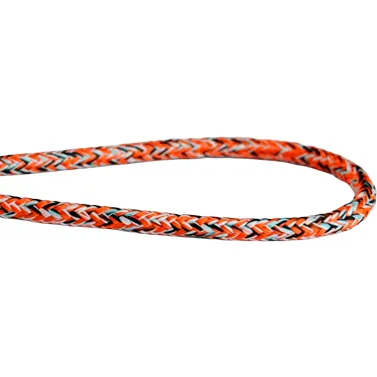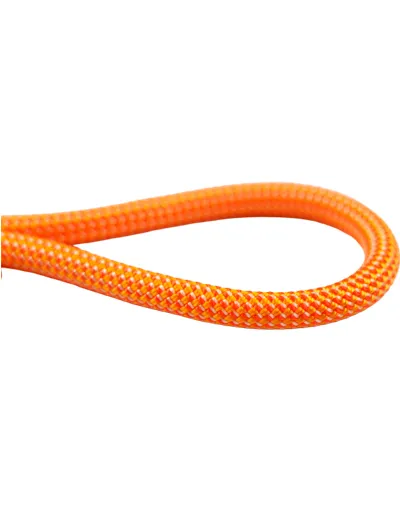
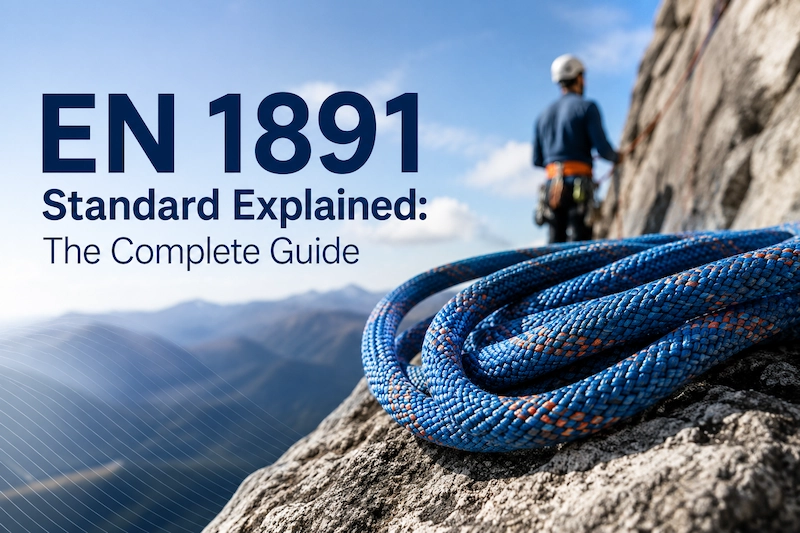
EN 1891 is the European standard that specifies safety requirements and test methods for low-stretch kernmantle ropes—commonly referred to as static rope. Published by the European Committee for Standardization (CEN), EN 1891 defines the minimum performance criteria that a rope must meet to be sold as certified low-stretch rope for professional and recreational use in Europe and many international markets.
If you're procuring rescue rope for a fire department, an industrial rope access team, a search and rescue unit, or a safety equipment distribution business, understanding EN 1891 is essential. It tells you exactly what performance you're getting, how to verify it, and how to ensure your procurement meets regulatory and operational requirements.
The standard applies to kernmantle ropes (core-and-sheath construction) with low elongation, designed for use in:
Rope access and work at height
Rescue operations (high angle, low angle, confined space)
Rappelling and abseiling
Caving and canyoneering
Safety and fall restraint systems (as part of a certified system)
EN 1891 does not cover dynamic climbing rope (that's EN 892) or general-purpose utility rope.
EN 1891 divides low-stretch ropes into two categories:
| Parameter | Type A | Type B |
|---|---|---|
| Intended use | Professional rescue, rope access, safety-critical applications | Less demanding applications, recreational use |
| Minimum diameter | 8.5 mm | 8.0 mm |
| Min. breaking strength (new) | 22 kN | 18 kN |
| Min. breaking strength with figure-8 knot | 15 kN | 12 kN |
| Max. elongation at 50 kg | No requirement (info only) | No requirement (info only) |
| Elongation at 10% min. breaking strength | ≤ 5% | ≤ 5% |
| Min. number of falls (factor 1, 100 kg) | 5 | 3 |
| Sheath slippage | ≤ 20 mm (over 2 m test) | ≤ 20 mm |
| Knotability | Must pass | Must pass |
For safety & rescue rope procurement, Type A is the standard requirement. Most professional organizations and regulations mandate Type A rope for any safety-critical application.
Understanding the tests helps you interpret manufacturer data sheets and verify that the rope you're purchasing meets the stated claims.
The rope is loaded in tension at a controlled rate until it breaks. The maximum force recorded is the breaking strength.
Type A minimum: 22 kN (approximately 2,200 kg or 4,900 lbs)
Type B minimum: 18 kN (approximately 1,800 kg or 4,000 lbs)
What this means for you: Breaking strength is the absolute maximum load before failure. Working load should never exceed 10–15% of breaking strength for safety-critical applications (typically yielding a 7:1 to 10:1 safety factor).
A figure-8 knot is tied in the rope, and the assembly is loaded to failure. Knots reduce rope strength because they concentrate stress at the bend points.
Type A minimum: 15 kN through a figure-8 knot
Type B minimum: 12 kN through a figure-8 knot
This test ensures that even when the rope is knotted—a common real-world condition—it retains sufficient strength for safe use.
Elongation is measured in two stages:
Preload at 50 kg: This removes initial slack and settles the rope. The elongation value here is recorded for information but has no pass/fail criterion.
Load at 10% of minimum breaking strength: For Type A, the rope is loaded to 2.2 kN (10% of 22 kN). Elongation must not exceed 5%.
The 5% limit is what defines "low stretch" under EN 1891. For comparison, dynamic climbing rope elongates 30–40% under impact—roughly 10× more than EN 1891 rope.
A 100 kg test mass is dropped in a factor-1 fall configuration (fall distance equals rope length). The rope must hold a minimum number of falls without breaking:
Type A: Minimum 5 falls
Type B: Minimum 3 falls
Important context: This fall test verifies that the rope has a minimum safety margin under shock loading. It does NOT mean EN 1891 rope should be used for fall arrest. Dynamic rope (EN 892) is designed for this purpose and absorbs far more energy. EN 1891 rope is tested to survive limited shock loads as a safety backup—not as a primary fall arrest system.
A 2-meter section of rope is cycled back and forth through a test device. The maximum distance the sheath can slip relative to the core is measured.
Maximum allowed: 20 mm over 2 meters of cycling
Excessive sheath slippage causes the rope to develop "baggy" sections where the sheath is loose over the core—a failure mode that makes the rope difficult to handle and can accelerate wear.
A single overhand knot is tied in the rope under a light load (10 N). The diameter of the knot loop is measured. If the loop is too small (indicating the rope is too stiff), it fails.
This ensures the rope can be tied into practical knots without excessive difficulty—a critical requirement for rescue and rope access work.
A rope sample is soaked in water for 24 hours, then dried. The change in length is measured.
Maximum shrinkage: Information only (no pass/fail), but excessive shrinkage affects real-world performance
Ropes that shrink significantly when wet can become shorter and stiffer than expected during rescue operations in wet conditions. Polyester-sheath ropes generally exhibit less shrinkage than nylon.
A compliant EN 1891 rope should have a technical data sheet that includes:
| Data Point | What to Look For |
|---|---|
| Standard reference | Must state "EN 1891 Type A" or "EN 1891 Type B" |
| Diameter | Nominal diameter in mm, with manufacturing tolerance |
| Weight per meter | In grams; compare across manufacturers for consistency |
| Breaking strength | Should exceed the minimum (22 kN for Type A); higher is better |
| Breaking strength with knot | Must meet minimum (15 kN for Type A) |
| Elongation at 50 kg | Informational; compare between products |
| Elongation at 10% BS | Must be ≤ 5%; lower is better for rescue applications |
| Number of falls | Must meet minimum; higher indicates greater safety margin |
| Sheath slippage | Must be ≤ 20 mm; lower is better |
| Sheath percentage | Ratio of sheath mass to total mass; affects durability |
| Core material | Nylon, polyester, or blend |
| Sheath material | Typically polyester (better UV/abrasion resistance) |
| CE mark | Required for sale in European market |
| Year of manufacture | Critical for shelf-life tracking |
EN 1891 mandates specific marking on each rope:
Inside the core, a continuous marker tape must be visible when the rope is cut. It must include:
Manufacturer name or identification
Standard reference (e.g., "EN 1891")
Rope type (A or B)
Diameter (e.g., "10.5 mm")
Year of manufacture (e.g., "2026")
CE mark or number of the notified body
This tape is your primary tool for verifying rope authenticity and tracking service life. Any rescue rope without a legible internal marker tape should be treated as non-compliant.
Some manufacturers also print identification on the sheath at intervals (e.g., every meter or every 5 meters), including:
Manufacturer name
Rope model
Diameter and standard
Sequential numbering (for length tracking)
Each end of a spool or cut length should carry a label with:
Complete product identification
Standard and type
Length (for cut lengths)
Batch number
Rescue rope is governed by different standards in different regions. Here's how EN 1891 relates to other common certifications:
| Standard | Region | Scope | Key Differences from EN 1891 |
|---|---|---|---|
| EN 1891 | Europe / International | Low-stretch kernmantle rope | The baseline standard discussed above |
| NFPA 1983 | United States | Life safety rope for fire/rescue service | Similar scope; uses different test methods and classifications (Personal Use vs General Use). NFPA 1983 also covers auxiliary rope and water rescue rope |
| ANSI Z359 | United States | Fall protection (as component) | Addresses rope as part of fall arrest systems; different from standalone rescue rope standard |
| AS/NZS 4142.3 | Australia/New Zealand | Fibre ropes – man-made fibre rope for static life-saving | Comparable to EN 1891 with regional adaptations |
| UIAA | International (climbing) | Dynamic rope only (EN 892) | Not applicable to static/low-stretch rope |
Yes, and many international manufacturers pursue dual certification. However, the test methods differ, so the rope must pass both sets of requirements independently. For global procurement—especially for organizations that operate across regions—dual-certified rope simplifies inventory and compliance.
When issuing a purchase order or RFQ for rescue rope, include these specifications:
Standard compliance: EN 1891 Type A (for professional use)
Diameter: 10.5 mm, 11 mm, or 12 mm (specify one or multiple)
Minimum breaking strength: Must meet or exceed EN 1891 Type A minimums
Core material: Specify if nylon, polyester, or blend is required
Sheath material: Polyester preferred for UV and abrasion resistance
Length per spool: Standard (100 m, 200 m) or custom
Color: Specify if color coding is required for different diameters or functions
Certificate of conformity (CE declaration)
Batch-specific test report (breaking strength, elongation, falls, sheath slippage)
Material traceability documentation
Internal marker tape specification
Shelf life and storage recommendations
Custom cut lengths with whipped or spliced ends
Sequential numbering on sheath
Color coding by diameter
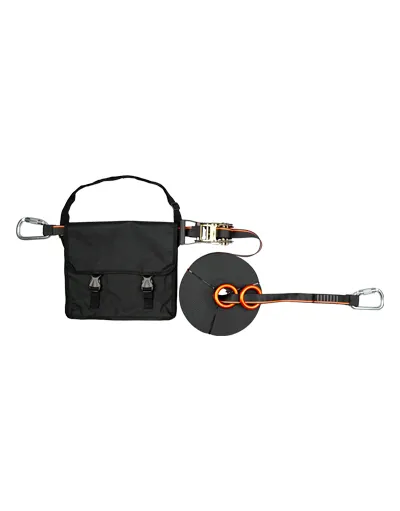
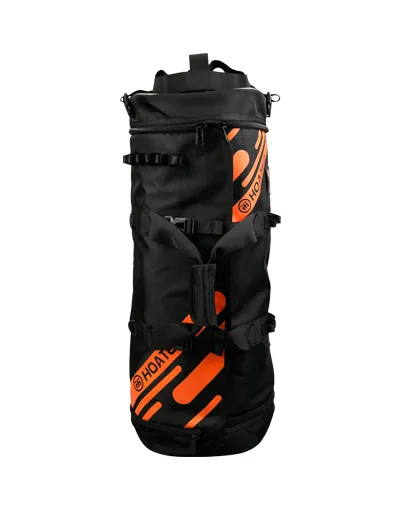
Pre-rigged kits (rope + bag + accessories)
Training documentation and technical support
A rope marketed as "low stretch" or "static" is not necessarily EN 1891 certified. Only ropes that have been tested by a notified body and carry the appropriate marking meet the standard. Always request the certificate of conformity.
Type B rope has lower minimum requirements and is intended for less demanding applications. Procuring Type B when Type A is required (as is standard for professional rescue) creates a compliance gap.
Certification applies to a specific production run, not to a product name in perpetuity. Rope from different batches should have individual test reports. If a supplier cannot provide batch-specific data, the certification claim cannot be verified.
EN 1891 certification applies at the point of manufacture. Aging, UV exposure, chemical contamination, mechanical damage, and improper storage all degrade rope performance over time. Certification does not guarantee performance for the life of the rope—inspection and retirement protocols are essential.
EN 1891 specifies nominal diameters, but actual manufacturing tolerances mean two "10.5 mm" ropes from different manufacturers may differ noticeably in actual diameter. This matters for compatibility with hardware (descenders, ascenders, pulleys). Always verify actual diameter with calipers on delivery.
The CE (Conformité Européenne) mark indicates that the rope complies with the applicable European directive—in this case, the Personal Protective Equipment (PPE) Regulation (EU) 2016/425. The number adjacent to the CE mark identifies the notified body that performed the conformity assessment. The CE mark is legally required for selling rescue rope in the European Economic Area.
Certification applies to the rope at the point of manufacture. There is no expiration on the certification itself, but the rope's service life is limited. Most manufacturers and safety organizations recommend retiring rescue rope after a maximum of 10 years from the date of manufacture, regardless of usage intensity—sooner if the rope has been damaged, shock-loaded, or stored improperly.
EN 1891 rope alone is not a fall arrest system. It is designed for applications where the user is secured under tension without dynamic falls. In a fall arrest system, EN 1891 rope could be used as a lanyard or restraint line, but only as part of a complete, certified fall arrest system that includes an energy absorber. For primary fall arrest (lead climbing), dynamic rope (EN 892) is required.
Cutting the rope does not void the EN 1891 certification, provided the rope itself remains unchanged. However, the cut ends should be properly finished (heat-sealed, whipped, or spliced) to prevent sheath-core separation. Document the original spool identification and batch number for traceability.
EN 1891 covers low-stretch (static) kernmantle rope used for rescue, rope access, and work positioning. EN 892 covers dynamic climbing rope designed to absorb the energy of a fall. They are fundamentally different products for fundamentally different applications. A rope cannot be certified to both standards simultaneously.
Request the following from your supplier: (1) the EC Declaration of Conformity, (2) the certificate issued by the notified body (identifiable by the CE xxxx number), and (3) batch-specific test reports. Verify that the internal marker tape in the rope matches the claimed certification details. If any of these cannot be provided, treat the rope as uncertified.
EN 1891 provides the framework for specifying, testing, and verifying low-stretch rope used in safety-critical applications. For procurement professionals, the key takeaways are:
Always specify Type A for professional rescue and rope access
Request batch-level test documentation from your supplier
Verify compliance through certificates of conformity and internal marker tape
Consider dual certification (EN 1891 + NFPA 1983) for international operations
Don't rely on marketing claims—insist on documented test data
Working with a manufacturer that provides comprehensive technical documentation, consistent batch quality, and full traceability simplifies procurement and ensures that every spool of rescue rope you deploy meets the performance requirements your operations depend on.
Explore HOATER's certified rescue rope range or contact our technical team for EN 1891 Type A rescue rope specifications and documentation.

 English